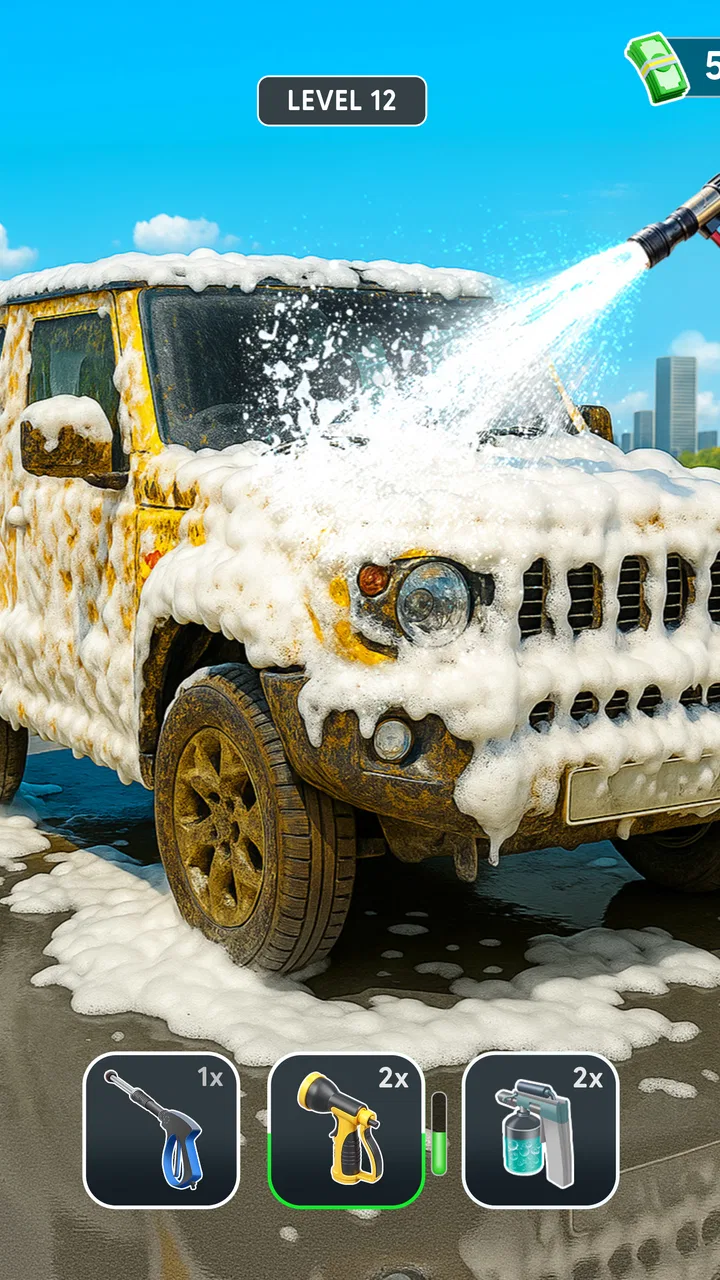
Car Wash: Auto Repair Garage
- 4.7
- Rating
- 50.00M
- Installs
- Free
- Price

 Analysis by App-foxy
I went into Car Wash: Auto Repair Garage expecting a very simple time-killer, and that is exactly what it is—although the hands-on cleaning loop is more absorbing than the short description suggests. This is a free role-playing game from HAPPY TAPPY STUDIO built around washing and repairing cars, with a deliberately repetitive rhythm that makes it easy to play in small bursts. I found myself enjoying it most when I wanted something calm, tactile, and uncomplicated rather than a story-heavy adventure or a demanding driving game.
The basic appeal is easy to understand. A dirty or damaged vehicle arrives, I work through the garage-style tasks, and the car gradually looks more presentable. The satisfaction comes from seeing a messy starting point become clean and finished. It is not trying to recreate professional mechanical work in serious detail, and it does not have the depth of a full vehicle-management simulator. Instead, it turns familiar car-care actions into a light game that can be picked up quickly.
How the garage loop feels in everyday play
The most useful way to approach the game is to treat each vehicle as a short routine rather than as a long campaign session. I begin by looking at what the car needs, then move through the available work in a steady order instead of tapping randomly. That small habit matters because the game feels smoother when I keep my attention on one task at a time. The visual change in the vehicle gives enough feedback to make each step feel worthwhile.
You May Also Like

 AccuWeather: Weather Radar
AccuWeather Review: A Quick, Clear Forecast for Everyday Decisions
For everyday plans, the best forecast is the one you can understand quickly. AccuWeather makes rain timing, radar, and local conditions easy to act on, with a few trade-offs.

 Hill Climb Racing
Why Hill Climb Racing Still Turns Crashes Into One More Run
A tiny car, a bumpy hill and one more upgrade: Hill Climb Racing keeps resurfacing because its simple chaos makes every near-miss feel personal.

 AliExpress - Shopping App
AliExpress Makes Global Shopping Feel Personal, but Shoppers Bear the Risk
AliExpress turns a global marketplace into a pocket-sized discovery engine. Its reach is useful, its shopping loop compelling, and its trade-offs easy to miss.

 Lords Mobile: Kingdom Wars
Lords Mobile Is a Kingdom-Building Routine, Not a Quick Match
A case-by-case verdict on the building, battles, device demands, and social commitments that make Lords Mobile rewarding for some players and exhausting for others.

 PDF Scanner app - TapScanner
TapScanner Makes Paperwork Easier to Capture, Check, and Share
TapScanner makes scanning with a phone feel less like a rescue operation and more like a dependable step in getting work done. Its capture tools are useful, though not flawless.

 Block Blast!
 Shows How Much a Puzzle Game Can Leave Out
A quiet grid game shows why puzzle players increasingly value instant clarity, repeatable skill and low-pressure play—and where the genre still needs to catch up.
More From Our News Desk
View All News


For a realistic everyday scenario, this fits well into a short break between errands or while waiting for an appointment. I can start a session without needing to remember a complicated plot, learn a large control scheme, or reserve a long uninterrupted period. A few minutes of cleaning and repair-style activity works as a reset after work. It is also suitable for someone who wants a game that can be understood immediately by a younger family member, although the Teen content rating means parents should still make their own decision about whether it is appropriate.
What I like about the baseline workflow is that it gives the game a clear beginning and end to each small job. The car is not merely an object on screen; it becomes a visual checklist. I notice the areas that still look unfinished, complete the next available action, and use the changing appearance as my guide. That makes the experience more satisfying than a menu-only idle game, because my input is connected to a visible result.
At the same time, the loop is intentionally narrow. If you need realistic diagnostics, open-world driving, deep customization, or a story with meaningful character choices, this garage will feel limited. The role-playing label should not lead you to expect the progression systems of a traditional fantasy or action RPG. Here, the role-playing element is better understood as a light progression wrapper around practical car-care activities.
The first-session routine I recommend
On a first visit, I would avoid rushing to tap every available control. I found it more useful to watch how the game presents the current job and identify which action produces the clearest visible change. Once that relationship becomes familiar, the rest of the session feels much more natural. This is a small point, but it prevents the early game from becoming a sequence of unplanned taps.
I also recommend playing with the phone held comfortably rather than trying to operate it one-handed while walking. The game is casual, but cleaning and repair actions still benefit from accurate touches. A stable grip makes the experience less frustrating, especially when the screen is busy or when I am trying to complete a task quickly.
Another practical habit is to finish a job before switching to something else. The game is more rewarding when I see the complete transformation, while jumping away midway can make the session feel fragmented. This is particularly helpful for children, who may enjoy the clear “before and after” result more than an abstract progress bar.
The title is free to download, which makes trying the core loop easy. It contains in-app purchases priced at $3.99 to $4.99 per item, so I would approach it as a free casual game first and decide later whether any optional purchase genuinely improves the way I play. I would not spend simply because a task feels repetitive; repetition is part of the design, and a purchase does not automatically change that fundamental character.
Settings and phone habits that make a difference
There is no reason to overcomplicate the setup, but I still check the available sound, notification, and display options before settling into regular play. In a quiet room, sound can make the actions feel more physical. In a shared space, I prefer a quieter setup so the game remains a private, low-distraction activity. The best choice depends on where I am playing, not on a universal “correct” configuration.
I also pay attention to battery and heat during longer sessions. A game based on repeated visual actions can encourage me to keep playing beyond the point where the novelty is strongest. If the phone begins feeling warm, I take that as a natural stopping point rather than treating the game like something that must be completed in one sitting. This is especially sensible on older devices, even though the game supports Android 8.0 and later.
The current version is 1.2.0, so I would keep the installed copy up to date through the normal app store process. That is not about expecting a particular new feature; it is simply a sensible maintenance habit for a game that may be played regularly. I also prefer to check the device’s general notification behavior, because a casual garage game is less enjoyable if alerts repeatedly interrupt the cleaning rhythm.
One setting-related trade-off is visual comfort. If the game offers display adjustments on a particular device, I would choose the option that keeps dirt, damage, and completed areas easy to distinguish without making the screen overly bright. The central pleasure depends on seeing progress clearly. A display that is too dim or too harsh can reduce the impact of the transformation, even when the underlying gameplay remains unchanged.
Faster patterns for repeat sessions
Experienced play is less about frantic tapping and more about consistency. I use a repeatable order: inspect the vehicle, complete the obvious cleaning work, deal with the repair-oriented steps, and then check the whole car before leaving the job. This sequence reduces backtracking and helps me notice unfinished areas. It is a simple workflow, but it makes the game feel considerably more controlled.
I also avoid switching between actions just because a different button catches my eye. The most efficient pattern is usually the one that follows the visual state of the car. When the vehicle still looks dirty, I stay with the cleaning task. When the appearance suggests that the next stage is ready, I move on. This keeps the session readable and stops the interface from dictating my attention.
For short breaks, I prefer completing one compact job rather than beginning several. That creates a satisfying endpoint and makes it easier to put the phone away. For longer sessions, I use the same routine repeatedly and take a pause when the visual changes start to feel less noticeable. The game’s strength is its soothing repetition, but that same repetition can become flat if I continue after the satisfaction has faded.
A less obvious benefit of this method is that it makes the game easier to share. If a friend or child asks to try it, I can explain the workflow in a few words: look at the car, follow the current task, and check the result. There is no need to hand over a complicated control guide. That accessibility is one reason the game works well as a casual household title, even if serious simulation fans may find it too lightweight.
I would also keep expectations realistic around speed. The game is not improved by treating every action as a race. A faster pattern means fewer unnecessary movements and less hesitation, not necessarily tapping as quickly as possible. Rushing can make the experience feel mechanical and may cause me to overlook the visual feedback that gives the cleaning loop its appeal.
Where the satisfying loop reaches its limits
The biggest limitation is variety. Washing and repairing cars can be pleasing for a while, but the central activity remains recognizable from session to session. Players who need constant surprises, complex objectives, or a large strategic layer may run out of interest sooner than players who enjoy repetition. I see this as a design boundary rather than a flaw, but it is important when choosing the game.
The game also sits between several familiar categories without fully replacing any of them. Compared with a driving game, it offers more tactile garage work and much less movement on the road. Compared with a serious mechanic simulator, it is faster, friendlier, and far less technical. Compared with a conventional role-playing game, it has a lighter sense of progression and no reason to expect elaborate combat, exploration, or character development. Its best comparison is with other relaxing task-based mobile games, where the pleasure comes from completing a visible transformation.
That comparison reveals the main trade-off. A traditional puzzle game may offer more varied problem-solving, while a vehicle customization game may provide more control over the final look. Car Wash: Auto Repair Garage is better when I want the process itself to be the reward. I do not need to plan a build or master a complicated puzzle; I simply enjoy taking a neglected car through a sequence of improvements.
The free-to-play structure is another point to consider. Since optional items cost $3.99 to $4.99 each, I would be cautious about buying anything before I know whether the repeatable loop holds my attention. Someone who only wants occasional relaxation may never need to spend money. Someone who plays often should decide whether an item changes the experience in a meaningful way rather than purchasing out of impatience.
The Teen rating is worth keeping in mind for families. The subject matter is a car garage, but the rating still applies to the complete presentation of the game. I would not assume that a vehicle-cleaning theme automatically makes it suitable for every child. For younger players, I would also supervise purchases and make sure the device’s purchase controls match the household’s rules.
The game has attracted a strong audience, with a 4.7 average from around 104 thousand ratings and over 10 million installs. Those figures suggest that the simple formula connects with many players, but they do not change the personal question: do I enjoy repeating small garage tasks? If the answer is no, popularity will not solve the underlying mismatch.
Who should install it, and who should skip it
I would recommend it to players who like tidy visual progress, short sessions, and uncomplicated touch interactions. It is a good fit for someone who enjoys watching a dirty object become clean, or for a casual player who wants a game that can be understood without a tutorial-heavy commitment. It may also suit fans of relaxing simulator-style activities who prefer cars to cooking, gardening, or room decoration.
I would be more hesitant to recommend it to anyone looking for a complete automotive hobby in game form. If you want authentic repair decisions, detailed parts, realistic vehicle handling, or a deep economy, this is not the right destination. A dedicated simulation game would be a better choice. Likewise, players who become bored when the same basic interaction returns repeatedly should try a puzzle, racing, or story-driven role-playing game instead.
It is also not ideal for people who want a game that rewards long-term planning. The strongest decisions here are about order, attention, and pacing, not about building a complex strategy. That can be refreshing, but it means the game is best used as a light activity rather than as a main game that occupies every spare hour.
My verdict after settling into the routine
After spending time with it, I see Car Wash: Auto Repair Garage as a focused relaxation game with a clear identity. Its best moments come from the clean visual feedback, the approachable garage workflow, and the ability to complete a small job without learning a complicated system. I especially appreciate that a repeatable order makes the experience feel smoother without requiring any invented shortcut or hidden technique.
Its weaknesses are just as clear: the activity can become repetitive, the role-playing label may set the wrong expectations, and optional purchases deserve a careful look before spending. I would not choose it for deep simulation or rich narrative. I would choose it when I want a quiet car-care loop that gives me a visible result and lets me stop whenever the session feels complete.
For me, the deciding test is simple. If the idea of restoring a messy vehicle sounds satisfying, the free download is easy to justify as a low-commitment experiment. Start with one job, use a consistent sequence, adjust the phone for comfortable play, and see whether the transformation itself holds your attention. If it does, this game can become a pleasant small ritual. If it does not, no amount of faster tapping will turn its deliberately narrow loop into a full-scale automotive simulator.
That makes the game a recommendation with a clear condition: install it for calm, repeatable garage work, not for depth. HAPPY TAPPY STUDIO has kept the concept direct, and the result is most enjoyable when I accept that simplicity instead of asking it to be something larger.
FAQs for Car Wash: Auto Repair Garage
01What features does Car Wash: Auto Repair Garage offer?
Car Wash: Auto Repair Garage offers a variety of features that include a detailed car washing simulation, auto repair tasks, and customization options. Players can choose from a range of vehicles to clean and repair, using realistic tools and techniques. The game also provides a garage management aspect, allowing players to upgrade their facilities.
02Is Car Wash: Auto Repair Garage free to play?
Yes, Car Wash: Auto Repair Garage is free to download and play. However, it does offer in-app purchases for players who want to enhance their gameplay experience. These purchases can include special tools, faster upgrades, or cosmetic items. It's important to manage these purchases to avoid unexpected charges.
03What age group is Car Wash: Auto Repair Garage suitable for?
Car Wash: Auto Repair Garage is designed for a wide audience, but it is particularly suitable for children and teenagers who enjoy simulation and management games. The game features colorful graphics and engaging tasks that are easy to understand, making it a family-friendly option. However, parents should supervise in-app purchases.
04Does Car Wash: Auto Repair Garage require an internet connection?
Car Wash: Auto Repair Garage can be played offline, making it convenient for users who may not always have a stable internet connection. However, certain features, like accessing leaderboards or special events, may require an internet connection. Playing offline means you may miss some online-exclusive content.
05What devices are compatible with Car Wash: Auto Repair Garage?
Car Wash: Auto Repair Garage is available on both Android and iOS platforms. It supports a wide range of devices, but it's recommended to have a device with a recent operating system version and sufficient storage space to ensure smooth gameplay. Check the app store for specific device compatibility details.
Pros
- User-friendly interface for all ages.
- Wide variety of vehicles to customize.
- Engaging graphics and animations.
- Frequent updates with new features.
- Offline mode available for play anytime.
Cons
- Contains in-app purchases for progress.
- Some ads may interrupt gameplay.
- Limited vehicle options in free version.
- Requires internet for initial setup.
- Occasional minor bugs in gameplay.

Car Wash: Auto Repair Garage
Gallery